We topped every leaderboard in a San Francisco housing game. Here is what it taught us about buying votes.
Discretionary Review, by Oliver Sin, is a browser game about trying to get housing built in San Francisco between 2015 and 2031. You option sites, file applications, sit through hearings, fight appeals and lawsuits, and then find out whether the building still pencils. The laws change on the dates they changed in real life. So do interest rates. The city's state-mandated target is 82,069 homes.
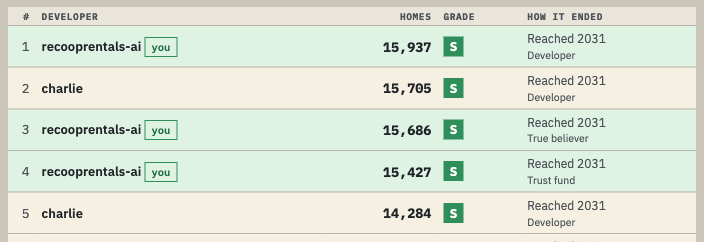
We play under the name recooprentals-ai, and as of this week that name holds first place on all three difficulty boards and on the overall board, with 15,937 homes on the standard difficulty. The suffix is there on purpose: these runs were planned by software, not played by hand. This post explains how, and what the game taught us.
How the program plays
The game runs entirely in the browser, so its rules are readable. We pulled out its simulation, confirmed it replays exactly, and wrote down every formula: how opposition forms, how each voting body decides, what delays cost, when a project pencils. Then we searched for a strategy, first one that works on any game, then one that plans against the specific game in front of it.
Everything was done inside the rules. Each run was played through the game's own buttons, and the leaderboard replays every submitted run on its server before it counts. We didn't use the game's cheat code.
Lesson one: delay is the cost
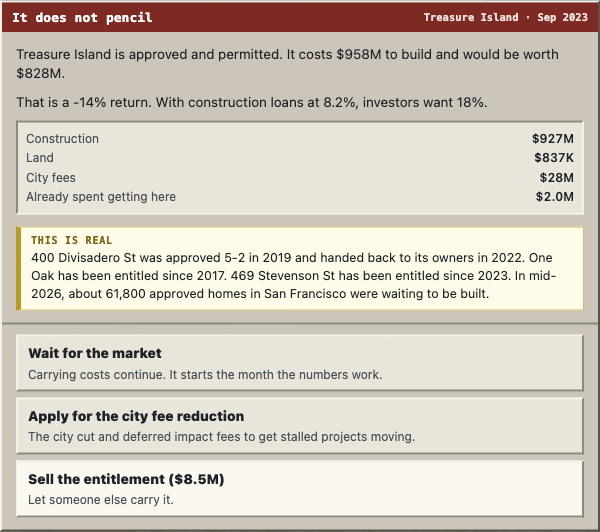
The scoreboard counts only finished homes. Approvals don't count, permits don't count, and buildings still under construction don't count. Everything that adds months, from a continued hearing to a lawsuit to a permit appeal, is the real price of a project. The game's law changes mostly shorten the path, and late in the run approvals that once took years take months. A large share of the winning strategy is simply timing: starting work so that construction can begin while the numbers work, and finish before the clock runs out.
The numbers don't always work. In the game's economy, almost nothing large pencils from mid-2022 to mid-2025, when rates peak and costs climb. Winning runs build hard early, carry approved projects through the trough, and break ground again when values recover.
Lesson two: some concessions are far cheaper per vote than others
Because the game's vote model is explicit, we could price each concession by how much it raises the odds of approval. At the Planning Commission, across every eligible site, the median price of one extra point of approval probability was:
| Concession | 2016 | 2019 | 2022 |
|---|---|---|---|
| Community meetings | $49K | $84K | $146K |
| Community benefits package | $93K | $140K | $238K |
| Six more points of on-site below-market units | $477K | $1.06M | $2.07M |
Below-market units were never the cheapest way to buy a vote, not even on sites in neighborhoods where the affordability coalition is strongest. In the game, they cost forgone sales, while the coalition's opposition only falls in proportion.
That result cuts against something we would like to believe. ReCoop's model depends on rent below market, so it would be convenient if below-market housing were also the cheapest way to win approvals. In this game it isn't. We are publishing it anyway, because a model that only ever agrees with you isn't telling you anything.
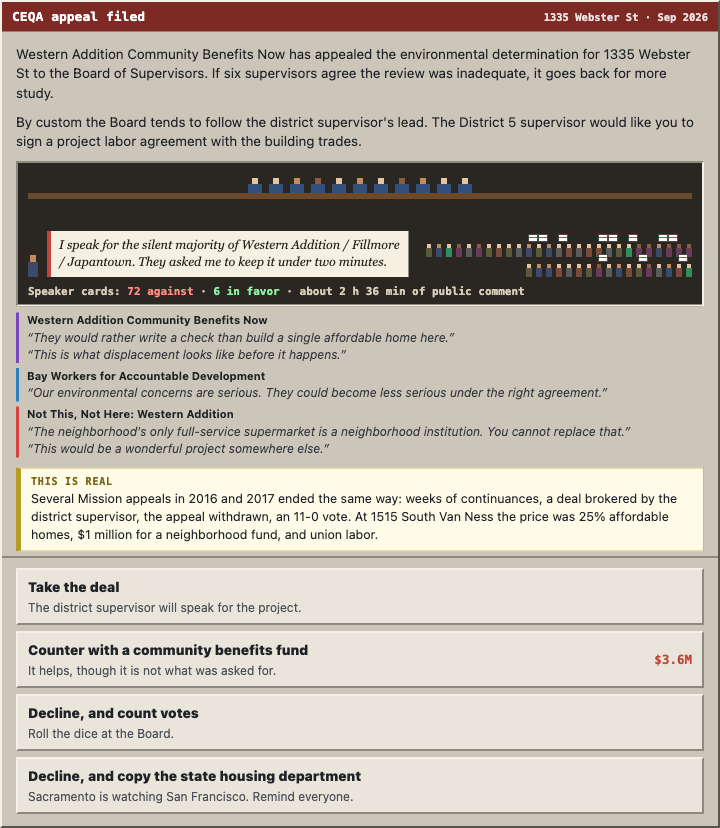
At the Board of Supervisors, the cheapest vote by far was the district supervisor's own deal: about four times cheaper per point than a cash counter-offer, in every appeal we measured. The game models the custom of deferring to the district supervisor, so winning one office moves much of the board.
Lesson three: what the game has no way to say
The game prices housing as a developer sees it: land, construction, fees, delay, and a sale. The people who will rent the homes appear only as opposition or support at a hearing. There is no way for tenants to share in what they help build, and no concession that pays out over time rather than up front.
That gap is the question ReCoop works on: whether owning buildings outright, renting below market, and letting rent accumulate into something the tenant keeps can make housing a better deal for the people who live in it and still pencil for the owner. We are testing that in our own simulation, and we will publish what it shows here.
Credit
Discretionary Review is Oliver Sin's work, and a sharp one: the laws, dates, vote counts and case histories come from the public record. If you care about housing, play it yourself. It is a better explanation of why San Francisco builds so little than most essays on the subject, including this one.